
10 Years Since the Paris Agreement: $79 Billion to Finance Foreign Arms Sales VS. $2 Billion for Green Climate Fund
By
Hanna Homestead
Posted:
|
Climate Change,
Military & Security
The Paris Agreement, adopted on December 12, 2015, was supposed to catalyze global investment in climate finance to assist the world’s most vulnerable and historically exploited countries combat the worsening climate crisis. Instead, over the past decade, Congress has approved roughly 40 times more taxpayer dollars to subsidize weapons companies than support the Green Climate Fund.
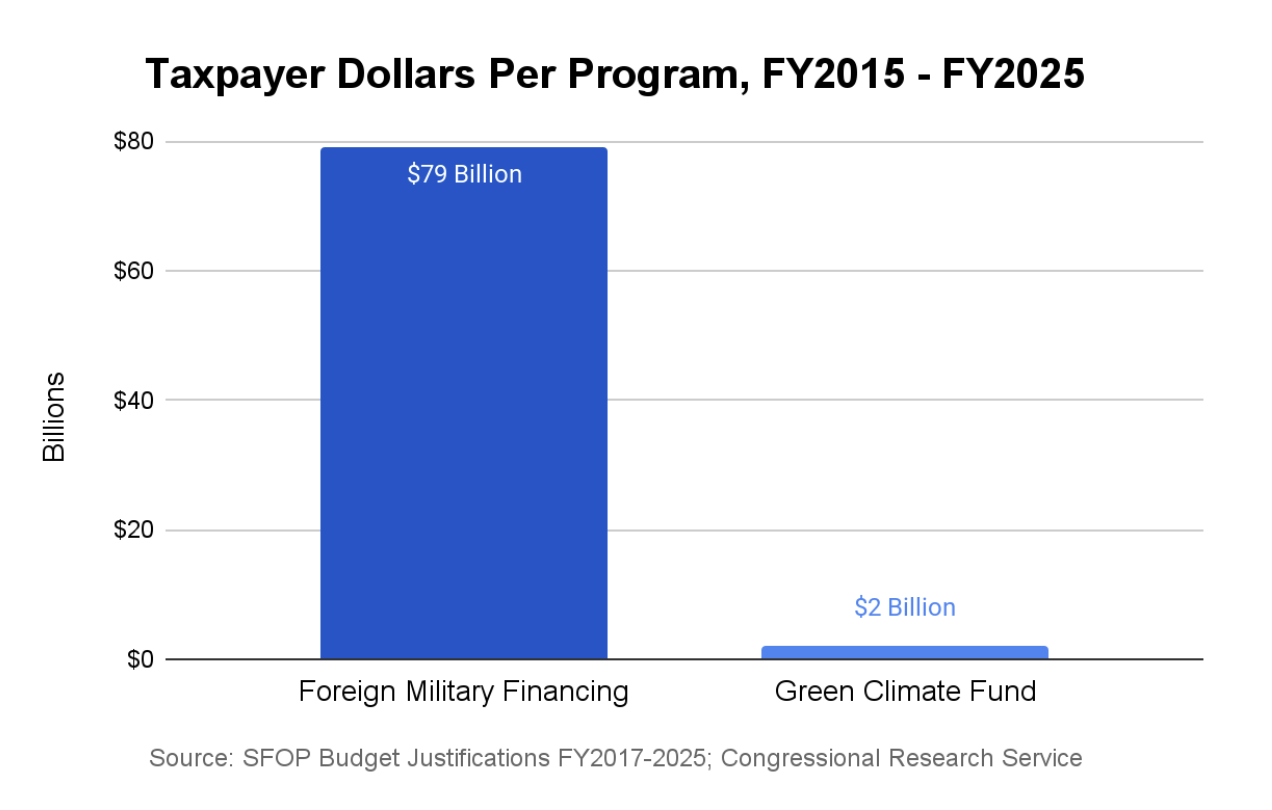
Since 2015, the United States spent $79 billion in taxpayer dollars on Foreign Military Financing (FMF), or grants the U.S. provides to foreign countries exclusively to purchase U.S.-made weapons. (FMF is just one of many types of foreign military assistance funded by U.S. taxpayers each year which benefits major arms dealers like Lockheed Martin.)
On the other hand, the United States contributed only $2 billion to the Green Climate Fund, the leading climate finance mechanism supporting countries least responsible for, yet most impacted by, the climate crisis. Despite being the world’s largest economy and largest historical carbon emitter, the U.S. ranks only sixth in pledged contributions to the Green Climate Fund.
The Paris Agreement explicitly states that wealthy countries bear the responsibility for providing climate finance, and designates the Green Climate Fund as the key mechanism through which wealthy countries should channel their support. Ten years later, the world’s wealthiest countries - including the United States - have fallen short of funding their fair share of international climate finance, leaving all nations more vulnerable to the devastating impacts of a warming world.
This is a policy choice that benefits fossil fuel corporations and weapons makers at the expense of people all over the world. In fact, a 2019 survey showed that 70 percent of Americans thought weapons sales made the U.S. less safe, and a 2022 survey found that three-quarters of U.S. adults support the United States participating in international efforts to help reduce the effects of climate change.
On the ten-year anniversary of the Paris Agreement, U.S. policymakers should rebalance foreign aid priorities and commit to providing a fair share of international climate finance. The U.S. government should be leading global efforts to prepare for and respond to the climate crisis it is most responsible for creating, not subsidizing corporations profiting from endless war, authoritarianism, genocide, and climate collapse.
For more, see last year’s fact sheet: Weapons for a Warming World.